The National Youth Service Corps (NYSC) is designed to harness the energy of graduates and promote national unity in Nigeria. It was established after the Nigerian Civil War to encourage cultural integration and bring young people from different regions together. Through NYSC eligibility, graduates get the chance to live and work in parts of the country different from where they grew up, helping them experience Nigeria’s diversity firsthand.
This NYSC eligibility guide is not just about who can go to camp. I will focus on those whom the program recognizes …basically, anyone who has business with NYSC at all. This includes graduates who will serve for 12 months, as well as those who will receive exemption certificates or exclusion letters.
Understanding these basic eligibility considerations is important because they form the program’s knowledge base. I will also point you in the right direction about articles you can read if you want to know more about specific categories, like who can actually go to camp.
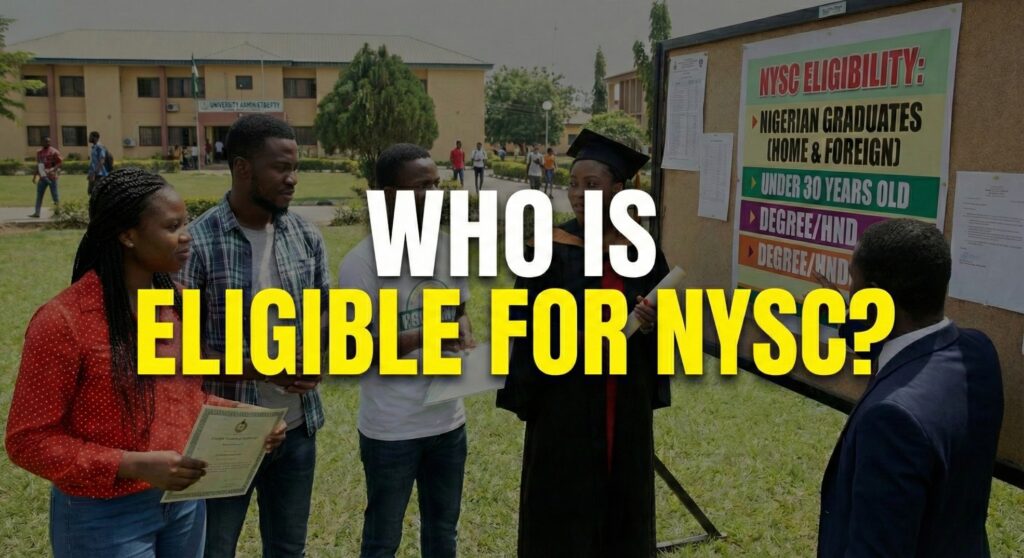
Eligibility Criteria for Participation in NYSC
The criteria for NYSC eligibility can be drawn from three main categories. These categories cover all graduates irrespective of their situation, whether they will go to camp, get an exemption, or be excluded.
The categories broadly focus on the person’s nationality, the type of education they have completed, and their age at the time of graduation.
Nationality and Citizenship
The first consideration for NYSC recognition is nationality. To be recognized by NYSC, a graduate must be a Nigerian citizen. This applies to everyone, whether they studied in Nigeria or abroad.
Part of meeting this criterion is having a valid National Identification Number (NIN). Without the NIN, NYSC will not recognize you, even if you have the right degree or meet other requirements. This applies to all graduates, including those who will attend camp as well as those who will receive an exemption or exclusion.
Educational Qualifications
The second consideration for NYSC recognition is the type of education a graduate has completed. To be recognized, a person must have completed a program at a tertiary institution, either in Nigeria or abroad.
For graduates from foreign institutions, NYSC recognizes programs that meet acceptable academic standards as determined by the Federal Ministry of Education.
Only graduates who did full-time programs are eligible to serve for the 12-month duration. Those who did part-time or distance learning programs will not serve. After registration, they are issued the NYSC exclusion letter.
As part of the educational requirements, those who will serve and go to camp are required to obtain the NERD clearance slip. Graduates who are excluded or exempted from service do not need this document.
The Age Limit for NYSC
The NYSC program is designed for youth. By definition, only graduates who are 30 years old or below at the date of graduation are considered within the youth category and eligible to serve for the 12-month duration.
Graduates who satisfy this age requirement and also completed a full-time program will go on to serve and attend camp. Those who completed a part-time program, even if under 30, will still be issued the NYSC exclusion letter, as mentioned earlier.
For graduates who exceed the 30-year age limit as at the date of graduation, they will not serve, even though they did a full-time program. Instead, they are issued the NYSC exemption certificate. The exemption is different from exclusion, and it recognizes that the graduate is formally part of the NYSC system, even though they will not participate in the 12-month service.
It is important to note that being above 30 does not mean a graduate cannot serve at all. What matters is their age at graduation. If they graduated while under 30, they remain eligible to serve whenever they are ready, even if they are 40 or older by the time they actually start the program.
Note: Graduates who are not yet 18 years old at the time of graduation are not eligible for NYSC.

Facts You Should Know About NYSC Eligibility
There are a few important facts about NYSC that many people find confusing, especially when trying to understand eligibility. Some of these facts relate to graduates who will go on to serve, while others apply to those who will be given exemption or exclusion letters.
National Service is Mandatory for Nigerian Graduates
NYSC is compulsory for every Nigerian graduate who has attended a tertiary institution. Once you earn a qualification from a recognized institution, you automatically have business with NYSC. That process may lead to service, exemption, or exclusion, but one way or another, NYSC must account for you. It is not optional.
For those who are eligible for service, the one-year participation is not negotiable. A graduate cannot decide to skip service and request an exemption instead. NYSC determines each person’s status based on its criteria, and that decision is final.
You Can Only Serve Once
NYSC recognition and service happen only once in a person’s lifetime. After a graduate has been mobilized and completed service, they cannot be called up again for another round of service, even if they later earn an additional qualification.
In the same way, once someone has been issued an exemption or exclusion letter, that status stands. NYSC does not process the same person twice under different categories.
📌 Advise: Join this NYSC Whatsapp Channel for the latest NYSC news today. The platform provides the latest information on 2026 Batch A Stream 2 and valuable tips for online registration.
Exemption Is Not Optional
Exemption is determined strictly by age at the time of graduation. Once a graduate falls into the exemption category under this rule, NYSC automatically assigns that status.
It is not a matter of choice. Someone who is exempted cannot later decide to serve, and someone who qualifies for service cannot choose to be exempted instead. NYSC fixes each person’s status according to its criteria, and that decision cannot be changed by preference.
The Exemption Certificate is Equivalent to the Discharge Certificate
The NYSC exemption certificate carries the same legal weight as the discharge certificate issued to those who completed the one-year service. Both documents show that the individuals have been officially recognized by NYSC.
The difference is not in validity but in category. One person served, while the other was exempted based on NYSC rules. In terms of official recognition, both certificates confirm that the graduate has fulfilled their NYSC obligation.
Academic Board Approval Is Non-Negotiable
For any graduate to be recognized by NYSC, their name must appear on the approved graduation list submitted by their institution’s Senate or Academic Board. This approval confirms that the person has officially completed their programme and has been cleared by the institution.
Without this approval, NYSC will not process the graduate, regardless of their age, course of study, or type of institution attended. The school must formally certify the graduation before NYSC will recognize the person.
Only Full-Time Programmes Are Considered For Service
Only graduates who did full-time programmes are eligible to serve in the NYSC scheme. This is the category that goes to camp and participates in the 12-month service.
Graduates who did part-time or distance learning programmes are still recognized by NYSC, but they don’t serve. Instead, they are issued an exclusion letter after registration.
Age is Calculated At The Date of Graduation
NYSC does not look at a graduate’s current age when determining their status. What matters is the age recorded at the time of graduation. This is the age that determines whether a person falls into the service or exemption category.
Even if a graduate is much older by the time they begin NYSC processing, it does not change their status. The decision is based entirely on how old they were on their graduation date.
NIN Is Compulsory for NYSC Registration
Under the NYSC eligibility, a valid National Identification Number is required for mobilization. Without the NIN, a graduate cannot register on the NYSC portal, regardless of the educational qualification or age at graduation.
This requirement applies to every graduate, regardless of whether they will serve, be exempted, or be issued an exclusion letter. It is a compulsory part of the process because it helps confirm nationality and ensures that a graduate cannot register for NYSC more than once.
What Happens If You Don’t Meet The Eligibility Criteria?
Since NYSC is a compulsory obligation for every Nigerian graduate, it is rare to find a graduate who is completely outside this system. The reason is simple. The program is designed for those with formal tertiary education. If a person has not attended a tertiary institution, they cannot be considered a graduate and are therefore not part of NYSC.
For graduates who meet the educational requirement but fall into other categories, such as being above the service age or having completed a part-time program, NYSC recognizes them differently. Those who are above the service age at graduation are issued an exemption certificate, while those who did part-time programs are issued exclusion letter.
Even though these graduates do not serve for the one-year duration, the documents they receive confirm that they have fulfilled their NYSC obligation as required by law. These certificates are valid for employment, public office, and any other purpose where proof of NYSC fulfillment is required. The system is simply structured to differentiate between those who will serve and those who are recognized but exempted or excluded.

Now that you understand how NYSC is structured, you can get a detailed explanation of the different categories by reading these guides:
- Requirements for Online Registration
- How to Apply for NYSC Exemption
- Requirements for Foreign Graduates
- How to Process NYSC Exclusion
If you have any questions or comments, leave them below.
People are also reading:
All You Need To Know About JAMB Matriculation List For NYSC
NYSC 2026 Calendar: See the Official Dates for Each Batch and Stream